
Author: admin

  • The socioeconomic gradient of health and COVID-19

    COVID-19 is more likely to present severely for older people and people with pre-existing medical conditions1. Pre-existing conditions, along with other health outcomes, are not equally distributed along socioeconomic lines. In this article we explore this relationship and what it means for Australia’s experience of COVID-19.

    People in lower socioeconomic areas tend to have poorer health. The NY Times recently explored this ‘socioeconomic gradient of health’ in its article Who Is Most Likely to Die From the Coronavirus? 2. The article referenced a University of California, Los Angeles study Trends in Health Equity in the United States by Race/Ethnicity, Sex, and Income, 1993-2017 whose authors concluded “what we now know about population health is that it is determined largely by social and economic policy factors”.

    We decided it would be interesting to see how these results translate to an Australian context. While we share many commonalities with the United States, there are some important differences. We have a very different healthcare system, lower income inequality and a different ethnic makeup. However, we know Australia certainly has its own ‘socioeconomic gradient of health’. The 2018 edition of the Australian Institute of Health and Welfare’s report Australia’s health found people with their socioeconomic status in the lowest fifth of the population were 1.5 times more likely to die from all causes than the fifth of the population with highest socioeconomic status3.

    Pulling apart the relationship between socioeconomic status and health is complex. A full analysis would correct for effects such as age, gender and ethnic background, all of which strongly contribute to the picture of Australia’s health. However, a focus on income is helpful as it brings the topic of inequality into sharp relief.

    Are people with lower incomes at higher risk of severe COVID-19?

    Using Australian Bureau of Statistics (ABS) data4,5 we looked at how the prevalence of four important risk factors for severe COVID-19 vary by household income. The four risk-factors are:

    • Asthma
    • Diabetes mellitus (‘diabetes’)
    • Heart, stroke and vascular disease (‘cardiovascular disease’)
    • Having three or more chronic conditions – i.e. at least three of: arthritis; asthma; back problems; cancer; chronic obstructive pulmonary disease; diabetes mellitus; heart, stroke and vascular disease; kidney disease; mental and behavioural conditions; and osteoporosis.

    The charts in Figure 1 compare the prevalence of these conditions to the median household income in a geographical area. Each point on the chart is one ABS ‘Statistical Area 2’ region, or SA2 region. An SA2 region is typically about the size of a postcode, or approximately 10,000 residents. The median prevalence is shown as a black horizontal line.

    Figure 1 – Rates of disease by median household income

    https://taylorfry.co.nz/wp-content/uploads/2020/07/figure1_v2.html

    Areas with lower household incomes have much higher rates of disease and chronic conditions. About 32% of SA2 regions have median household incomes below $50,000. Visually, most SA2s in this category have higher than median rates of the risk factors. For these regions:

    • 95% have above-median rates of ≥3 chronic conditions
    • 86% have above-median rates of asthma
    • 84% have above-median rates of diabetes
    • 92% have above-median rates of cardiovascular disease.

    These rates are incredibly high when compared regions with higher household incomes. For example, the proportion of regions with above median rates of cardiovascular disease is three times higher where the median income is less than $50,000, compared to regions with median incomes of $50,000 or more.

    How does the socioeconomic gradient of health vary across different states and territories?

    Figure 2 takes the SA2 regions within each state and territory and:

    • Orders the SA2 regions by median household income and groups them into deciles (where decile 1 is the group of SA2 regions with the lowest median household incomes, and decile 10 is the group of SA2 regions with the highest median household incomes)
    • Graphs how the incidence of the four risk factors (the coloured lines) varies by household income.

    To make the different states and territories more comparable, each set of lines is centred around the median for that state or territory.

    Figure 2 – Difference compared to the median by household income decile for all States and Territories

    https://taylorfry.co.nz/wp-content/uploads/2020/07/figure2_v2.html

    In New South Wales:

    • The rate of cardiovascular disease and the rate of diabetes are both 50% above the median for the lowest household income decile.
    • The rate of cardiovascular disease and the rate of diabetes are 20% lower and 30% than the median among the highest household income decile.
    • The combined effect can be seen in the rate of having three or more chronic conditions. This is 80% above the median for the lowest household income decile. It is 40% lower than the median among the highest household income decile.

    New South Wales has the steepest health gradient for multiple chronic diseases out of all states and territories. The gradients are similar to those seen in the United States.

    Most other states show significant gradients also. For example, Queensland has a particularly steep curve for diabetes. Tasmania and the ACT have the shallowest socioeconomic health gradients. ACT is perhaps understandable since it has relatively lower income inequality and is highly urbanised. The flatter curve for Tasmania reflects slightly different dynamics. Tasmania has the least income inequality of all the states/territories, combined with a higher overall rate for each of the risk factors (in part due to an older age profile).

    Older people are more likely to have chronic illnesses. This means differences in the age profile will contribute to the slopes. We note, firstly that previous research found the socioeconomic gradient still exists within age bands6. Secondly that when we used the rates of disease among those aged 60 and over (rather than in the SA2), the gradient was still present albeit shallower.

    The socioeconomic gradient of health exists in all states and territories. It is steepest in New South Wales, Queensland and Victoria, and shallower in the ACT and Tasmania.

    What does this add up to?

    The socioeconomic gradient of health is not new, and it exists for a range of reasons. For instance, those with higher incomes tend to have better housing and working conditions and are less exposed to dangerous environments, among other things7. But the heightened risk of poor health outcomes during COVID-19 draws attention to its implications.

    As at early July, Diabetes Australia reports people with diabetes represent 7% of diagnosed cases of COVID, 17% of hospitalised cases, 24% of ICU stays, and 25% of deaths in Australia8. A meta-analysis on COVID-19 and diabetes found COVID-19 patients with diabetes have more than two times the risk of developing severe COVID-19 and nearly two times the risk of mortality9. Another meta-analysis explored various comorbidities for COVID-19 patients and found hypertension, respiratory system disease, and cardiovascular disease were 1.4-2.4 times more likely among severe-COVID-19 cases than non-severe10.

    It is still early days in our understanding of the COVID-19 virus. It is likely some time away before we know the exact elevation in risk of severe COVID-19 associated with having an existing chronic illness. These early numbers indicate those with a chronic illness may be at two-to-four times the risk of severe COVID-19.

    What does this mean? In NSW, for example, areas with the lowest decile of household incomes have rates of chronic diseases 1.6-2.1 times higher than among areas with the highest decile of household incomes. Applying the Diabetes Australia ratios directly, this implies if there was an outbreak in these regions, they could see 3-8 times the rate of severe-COVID-19 cases.

    What should we take from this? As the threat of a second wave of cases looms in Australia, it is important to remember the risk of developing severe complications from COVID-19 is not distributed equally along socioeconomic lines. In the short term, this has implications for how governments think about staffing, testing, and hospital capacity. In the longer term, it has the opportunity to spark a continued focus on ‘health justice’, or as the authors of the UCLA study comment “when our politics starts to work better for those left behind, then their health will improve”.


    References
    1World Health Organisation, COVID-19: vulnerable and high-risk groups. Available from: https://www.who.int/westernpacific/emergencies/covid-19/information/high-risk-groups
    2NY Times, Who Is Most Likely to Die From the Coronavirus? Yaryna Serkez June 4, 2020. Available from: https://www.nytimes.com/interactive/2020/06/04/opinion/coronavirus-health-race-inequality.html
    3Australia’s health 2018, The Australian Institute of Health and Welfare. Available from: https://www.aihw.gov.au/reports/australias-health/australias-health-2018/contents/table-of-contents
    4Australian Bureau Statistics. National Health Survey: Small Area Estimates, 2017–18 — Australia. Available from: https://absstats.maps.arcgis.com/apps/MapSeries/index.html?appid=bacd58f73b554c329f431ceb02ef9ab8
    5Australian Bureau Statistics. Census 2016 – total household income. Available from: http://stat.data.abs.gov.au/Index.aspx?DataSetCode=ABS_C16_T21_SA#
    6Mather et al. Variation in health inequalities according to measures of socioeconomic status and age. Australian and New Zealand Journal of Public Health (2014). Available from: https://onlinelibrary.wiley.com/doi/full/10.1111/1753-6405.12239
    7World Health Organisation. Social determinants of health. Available from: https://www.who.int/social_determinants/thecommission/finalreport/key_concepts/en/
    8Diabetes Australia, https://www.diabetesaustralia.com.au/covid19 accessed 9 July 2020
    9Kumar et al. Is diabetes mellitus associated with mortality and severity of COVID-19? A meta-analysis, Diabetes & Metabolic Syndrome: Clinical Research & Reviews 2020. Available from: https://www.sciencedirect.com/science/article/pii/S1871402120301090
    10Jang et al. Prevalence of comorbidities and its effects in patients infected with SARS-CoV-2: a systematic review and meta-analysis, International Journal of Infectious Diseases 2020. Available from: https://www.ijidonline.com/article/S1201-9712(20)30136-3/abstract

  • COVID-19: What’s really driving CTP costs?

    As consumer groups advocate strongly for relief in CTP insurance – saying a decline in car usage and risk due to pandemic restrictions justifies the move – pressure is on insurers to discount premiums. But the proposition is far more complex than it seems and the devil is in the details.

    With the country, indeed the world, in the midst of a social and economic lockdown, one of the more visible impacts has been that people are driving less. There are notably fewer cars on our roads – confirmed by publicly available mobility data from government (e.g. Transport for NSW[1]) and from the omniscient tech giants Google[2] and Apple[3].

    Does less traffic on the road mean fewer accidents? Likely, yes, to some extent. But this question generally arises because people are actually interested in knowing whether it warrants a reduction to their CTP car insurance premiums. Are drivers now paying too much for insurance?

    Answering this question isn’t straightforward. We’ll look into it by asking more targeted questions:

    • Who is driving less? Insurance is a risky business, in that each of us has a different risk profile and, from the insurers’ perspective, a different expected cost (known as the ‘risk cost’). Is everyone driving less? Or just the higher-risk drivers – such as young people with older cars and a history of previous accidents? Or is it the lower-risk group – including recent retirees with a new car who haven’t made a claim for years? If it’s the former, then the number of accidents will fall by more than if it’s the latter. Of course, there are many more factors that affect the cost of CTP insurance and these need to be re-investigated and understood in a COVID-19-affected world.
    • Where are people driving less? In city centres, accidents are relatively lower speed with comparatively less damage[4]. Are people driving less in these areas? Or are the reductions also out on the highway where accidents have, on average, more serious repercussions?
    • How has driving behaviour changed? Are people driving faster or slower? Having fewer vehicles on the road might actually translate into drivers travelling at greater average speed. Higher-speed accidents tend to result in a greater degree of damage and higher cost. And are there other adverse effects on driving ability and behaviour that stem from a prolonged period of home stay and social restriction?
    • Are there other effects of COVID-19? Many other dynamics influence the price of insurance, ranging from the availability and cost of imported vehicle parts in motor property insurance to the investment income allowed for in setting premiums for CTP insurance. Adverse movements in these areas could offset, at least partially, any reduced costs due to fewer claims.
    • How long will current conditions last? How severe will the economic downturn be? How long will there be less traffic on the road? Will traffic volumes rebound quickly, or will they be reduced for a year or more?

    Answers to the above questions affect the cost of insurance – and therefore also affect how much an insurer can afford to offer as a rebate for the reduced traffic volumes resulting from COVID-19. The reported 50 per cent reduction in traffic volume will likely reduce the cost of claims for insurers. But that reduction in claims cost could be quite different from 50 per cent.

    Some motor (property damage) insurers[5] have already started to offer premium rebates on an opt-in basis. The magnitude of these rebates is much less than the 40 to 50 per cent reductions observed in traffic volumes.

    CTP insurance is especially complicated

    While the impact of COVID-19 on insurance is complicated, CTP insurance is especially complicated.

    Compulsory Third Party (CTP) insurance (or ‘green slip’ insurance as it is known in NSW) protects vehicle owners from the significant financial consequences of injuring someone through the use of the vehicle. There are several characteristics of this insurance that make setting premiums particularly challenging, even at the best of times.

    CTP claims are infrequent, but costly when they do occur

    The expectation that a CTP claim will arise is, on average, very low. Over their entire life, most people will never injure themselves or another person through the use of their vehicle, and so will never trigger this insurance. The expectation of a claim in any given year is typically lower than one in 400 – meaning, on average, a person would need to drive and be insured for more than 400 years to give rise to a single CTP claim. With such a low incidence of claims, even an insurer with a large CTP portfolio will need several months of claims data to be able to reliably estimate claim frequency reductions for different policyholder segments.

    In further contrast to comprehensive motor claims, CTP claims are large, complicated and often take years to settle. Claimants’ injuries take time to stabilise and their health outcomes can be affected by issues such as access to medical services, depression and anxiety, and insurers’ ability to pro-actively deal with their claims. Their economic losses can be affected by their employment situation.

    It’s likely COVID-19 and the resulting economic situation will impact all these factors, and therefore the size of CTP insurance claims. To what extent, we don’t yet know. It will be several years before these impacts can be reliably quantified.

    CTP insurance is ‘community rated’

    Community rating means the total costs of CTP insurance are averaged and borne across the entire community of vehicle owners. In other words, premiums don’t fully reflect the different risk profiles of each individual – a significant part of the expected cost of high-risk vehicle owners is shared by the low-risk vehicle owners. Why community rate? It keeps premiums more affordable for all, ensuring a viable system.

    This restricted approach to pricing (where low-risk policyholders subsidise the premiums of high-risk policyholders) means that for any individual, their premium is not just about them – even if an individual is driving less, their insurer can’t offer them a premium rebate based just on this. The insurer needs to know what is happening across all of the policyholders in its CTP portfolio, so it can offer an average rebate that takes everyone into account.

    Put another way, community rating means a better-than-average CTP risk pays a large part of their premium to cover the expected claims from other drivers that are worse than average. This component of their premium is unaffected by how they themselves drive – it depends on the behaviour of others.

    CTP insurance is regulated

    As the name makes clear, CTP is a compulsory insurance. For this reason, it’s more highly regulated than most other insurance products. State governments either provide the insurance directly or they regulate the prices and services of insurers. In the latter case, premium rebates under consideration would necessarily involve input from more stakeholders and would take more time to work through and implement.

    So, what does this mean for CTP insurance?

    CTP scheme regulators will no doubt come under pressure to facilitate a reduction in premiums, given the visible reduction in vehicle use. Consumer advocate group One Big Switch has already indicated that its “… first goal is to get state governments to agree that some relief is fair and deliverable – the details will come next”[6].

    But the devil is in those ‘details’, and any rebates given in the short term will require educated guesses from both regulators and insurers, the effects of which won’t be known for some years. This guess work will be more uncertain than it is for comprehensive motor and it will take longer to be validated by the experience. Using historical scheme data, regulators are well placed to analyse the link between traffic volumes and CTP claims to best interpret the changes we are seeing during this pandemic, enabling both regulators and insurers to make sounder decisions.


    [1] https://www.rms.nsw.gov.au/about/corporate-publications/statistics/traffic-volumes/
    [2] https://www.google.com/covid19/mobility/
    [3] https://www.apple.com/covid19/mobility/
    [4] https://www.bitre.gov.au/sites/default/files/Road%20trauma%20Australia%202018%20statistical%20summary.pdf
    [5] https://www.youi.com.au/car-premium-relief#howitworks
    [6] https://www.insurancenews.com.au/daily/pressure-on-ctp-schemes-as-push-for-premium-relief-grows

  • COVID-19: Working from home and mental health

    Amid the chaos and calamity of the past few weeks, and into the weeks and months ahead, workers compensation schemes face an unprecedented scenario: most white-collar workers doing their jobs from home.

    In response, employers will be acting to ensure safe environments are in place to avoid potential physical injuries to their staff while working from home. Given the increased isolation in an uncertain world, it is equally important to recognise that many of the risk factors for psychological injury will also be heightened during these times.

    Employers across the world are trying to protect their workers from exposure to the COVID-19 virus and do their bit to slow its spread. If an employee contracts the virus and work is proven to be the main contributing factor, the workers compensation scheme or self-insured employer will be liable. However, determining whether or not claims are compensable will not be straightforward. Schemes have already indicated that these matters will need to be addressed on a case-by-case basis.

    This crisis has implications for schemes and employers beyond the immediate risk of contraction. Employers have a responsibility to provide a safe work environment for their employees, and as white-collar workers move to working from home, employers are:

    • Obliged to ensure workspaces meet OHS standards
    • Liable for injuries incurred during the course of working from home.

    The almost overnight change in working arrangements has resulted in plenty of short-term teething issues, with reports that office chairs, desktop monitors and standing desks are sold out. Australian workplaces have responded with common sense, and many employers are allowing workers to take office furniture home. Nevertheless, some physical injuries while working from home will be sustained, having a financial impact on schemes and self-insured employers. While this presents a challenge, the much larger challenge is likely to be maintaining the mental health of the workforce while increasingly strict social isolation measures are enforced.

    Before the arrival of COVID-19, Australian schemes were already grappling with the growing number of work-related mental injuries. Safe Work Australia estimates that each year about 7,200 Australians are compensated a total of more than $500 million for the mental injuries sustained during their employment. Mental injury claims can also be more challenging to manage for schemes. As Safe Work Australia reports, these claims typically involve lengthy periods of absence from the workforce, contributing to a median direct cost for mental injury claims that is significantly higher than observed for all workers compensation claims[1].

    In the COVID-19 environment, we expect workplace mental injuries to rise even further.

    1. Heightened risk factors for mental injury claims

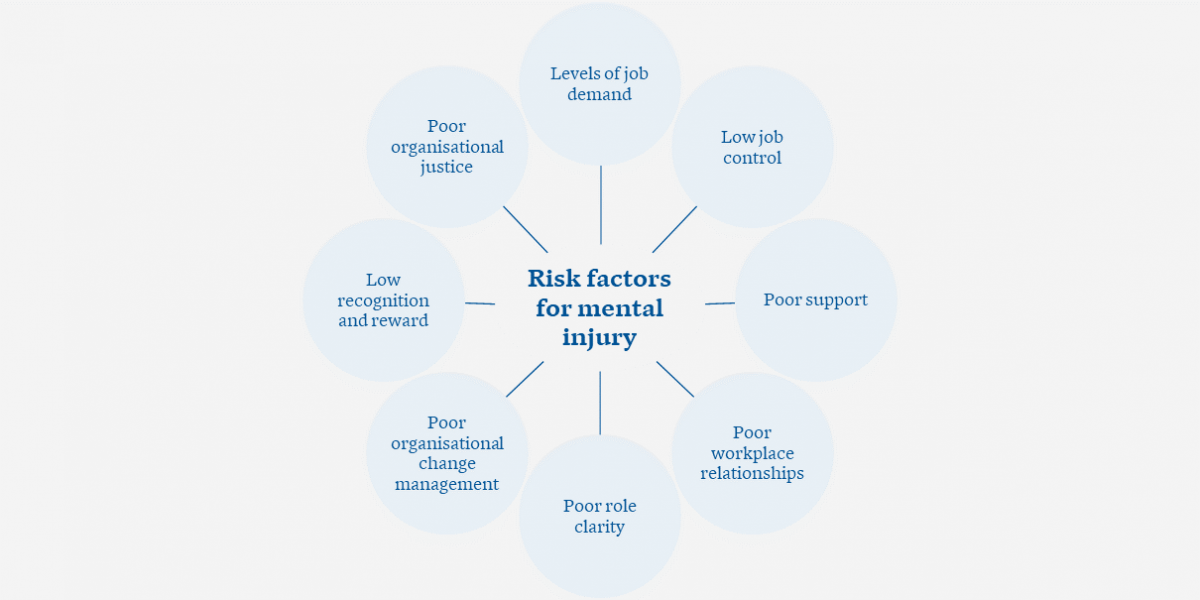
    In Figure 1 below we list the risk factors for mental injury, as outlined by Safe Work Australia[2].

    Figure 1 – Risk factors for mental injury

    It is likely that most, if not all, of these risk factors will be heightened with a workforce that is working remotely. For instance, demands on some employees may increase in times of crisis, which may result in low recognition and reward if communication and support channels for remote work are poorly established. As employers adapt to a new way of working, workers may have less input into decisions about the way they work. Role clarity may be difficult to establish as oversight by managers proves challenging in a virtual world.

    1. Increased uncertainty and stress

    Uncertainty creates stress and stress can exacerbate the risk factors identified above. Stress and anxiety associated with keeping a job or returning to work are generally heightened in an economic downturn, and may be even more so with the current health threat. It is plausible that many workplaces will need to undergo significant organisational change and some jobs may not be there to return to. Meaningful connection to the workplace may be dampened without the day-to-day in-person comradery and banter between colleagues. Work and home life might blur together, further increasing stress levels, and affecting productivity, whether or not workers claim for mental injury.

    1. Greater impact on vulnerable workers

    COVID-19 and its social consequences will almost certainly have a disproportionate effect on our most vulnerable. We know that those with pre-existing co-morbidities, whether work related or otherwise, are vulnerable to anxiety, stress and depression. These vulnerabilities are carried into the workplace, making those people even more susceptible to harm, now more than ever.

    The cost of these heightened hazards will not be known for some time because employers have reduced visibility of the typical mechanisms for mental injury, such as stress, fatigue and bullying. Given this, it is important employers consider the behaviours and activities they can take to reduce the isolation of employees. Schemes (such as Comcare[3]) are beginning to release material to encourage these behaviours and share best practice.


    1. https://www.safeworkaustralia.gov.au/system/files/documents/2002/psychosocial-health-and-safety-and-bullying-in-australian-workplaces-5th-edition.pdf
    2. Adapted from: https://www.safeworkaustralia.gov.au/system/files/documents/1702/preventing-psychological-injury-under-whs-laws.pdf
    3https://www.comcare.gov.au/prevent-harm/coronavirus

  • Trouble at home:
    The breakdown of property-owner protection and how to repair the damage

    Highly publicised systemic failures have revealed deep problems in the construction industry. We explore the major issues as the industry confronts the challenges of rebuilding trust and reputation.

    Mass evacuations due to major structural defects, and increased fire safety risks due to the use of non-compliant combustible cladding – are just two of the issues in the past year that have led to nationwide inquiries. These inquiries have ranged from investigating the adequacy of consumer protection and the regulation of building standards to the role of private certifiers, and the implications of the absence of affordable and unrestricted professional indemnity insurance.

    Many questions remain unanswered. Who should be held liable when defects emerge? What protections are in place for residential owners and what are the gaps in protection for those who own high-rise dwellings? Lastly, what are the changes needed to address the problems?

    First things first …

    Who should be held responsible for defective work?

    The answer is complex and often unclear, resulting in dissatisfaction among property owners with the lack of accountability and long delays in finding a resolution.

    • Developers and builders are often considered first, as they executed the build. However, builders and developers typically have limited capital to call upon to fund rectification work. In addition, the company that executed the development may have been established to undertake the specific project and therefore wound-up on completion.
    • Engineers, architects and surveyors are typically considered next. The defects may have occurred as a result of faulty design, inadequate testing or insufficient scrutiny. As part of their licensing (or registration), engineers, architects and surveyors are required to hold professional indemnity insurance. Recently, underwriters have responded to the increase in risk by increasing premiums and adding exclusions (which is an issue for the professions above), or withdrawing from underwriting construction-related risks altogether. This has placed pressure on the ongoing operation of engineers, architects and surveyors.
    What protections are in place for residential property owners?

    Home-building compensation schemes operate in every Australian jurisdiction, where the builder purchases insurance cover on the homeowner’s behalf prior to commencing the project. This insurance cover is compulsory in every jurisdiction except Tasmania, where it is voluntary. These schemes cover:

    • Low-rise residential developments up to three storeys only
    • Major/structural defects for approximately six years following project completion
    • Minor/non-structural defects for up to two years following completion

    The Queensland scheme is a first-resort scheme, where the property owner makes a claim and the scheme will pursue the builder regardless of whether the builder is still trading. Every other jurisdiction operates a last-resort scheme, where the builder is required to have become insolvent, have died or disappeared before a claim can be made against the scheme.

    Where homeowners are vulnerable

    There are few protections in place for residential property owners of high-rise apartments that are more than three storeys. In the mid-to-late 1990s and early 2000s, the private sector in New South Wales and Victoria provided builders’ warranty insurance cover to high-rise homeowners, but cover was withdrawn following large losses. Following similar large losses, the South Australian and Western Australian Governments offered reinsurance to private insurers to keep them afloat.

    In NSW, from the start of 2018, developers have been required to lodge a bond with NSW Fair Trading equal to two per cent of the contract value, which can be called upon to cover defective work. The bond is held up to two years and is released following an inspection, provided no defects are identified.

    The cover provided is limited – two per cent of the contract value is unlikely to meet the cost of rectifying major defects. In addition, defects will need to be identified within two years before the bond is released for owners to benefit from the introduction of the requirement. For example, the bond would not have provided protection to Mascot Towers homeowners when cracks were recently identified in the 10-year-old building.

    What needs to change?

    To provide adequate consumer protection, significant change is required. Below, we outline the changes that could help strengthen the construction industry and protect all homeowners.

    Change neededWhat it might look like
    Strengthen licensing and prudential requirements for builders and developers– Ensure builders and developers hold adequate capital so that defects can be rectified when they emerge
    – Introduce regular monitoring and reporting of capital position
    – Introduce fit and proper requirements for developers and builders
    – Maintain a register of directors and a commitment to prevent an individual being registered if they do not meet the standards
    Greater inspection and oversight to reduce the number of defects and cost of rectifying defects– Conduct inspections during the build, the frequency and detail of which depend on the project’s complexity
    – Ensure independent certifiers conduct the inspections
    Appropriate homeowner protection to provide a safety net– Have the regulator or insurer perform the risk assessment on the homeowners’ behalf, instead of only becoming involved once the builder is insolvent, has died or disappeared
    – Extend coverage to homeowners of high-rise developments in a different scheme
    – Ensure regulation, monitoring and insurance work together to promote efficiency and sustainability

    These changes will come at a cost to the construction sector (and presumably homeowners). Ultimately, those responsible for implementing change will need to weigh this additional cost against the current costs (financial and other) associated with incomplete or defective work, which is severely impacting residential property owners.

  • Insurance product update:
    Am I meeting the needs of my target market?

    Putting people first is more important than ever, as insurers face intense scrutiny under obligations coming into effect early next year. Taylor Fry’s Kevin Gomes and Scott Duncan team up with Mark Lindfield, of Lander & Rogers, to help prepare you for the changes

    A focus on the customer is at the centre of new laws governing the design and distribution of insurance products, reflecting a broader culture shift throughout the industry, following last year’s financial services royal commission.

    With little more than 12 months before the new laws come into effect and with the Australian Securities and Investments Commission (ASIC) seeking input as to how it should administer them, it’s timely for insurers and distributors to familiarise themselves with their new obligations.

    We explain what’s required, what ASIC expects and what you should look out for …

    Where did the new laws originate?

    For the past 15 years, the preferred approach of regulators and legislators has been to attempt to improve consumers’ financial literacy through guides, product disclosure statements, statements of advice and fact sheets. More recently, and due particularly to Commissioner Kenneth Hayne’s findings, there has been an appreciation for boards and senior management to do more.

    While consumers should remain responsible for their decisions to acquire financial products, issuers and their distributors are now being called on to focus squarely on customer needs when designing products, and to continually review whether the products are designed and distributed in a way that’s likely to meet the needs of their target market.

    This idea of taking a more client-centric approach is not new. Back in 2014, a report by the independent Financial System Inquiry recommended a targeted and principles-based product design and distribution obligation. This would require issuers and distributors to consider not only commercial considerations when designing products, but also the type of consumer whose financial needs would be addressed by buying the product and the channel best suited to distributing the product.[1]  That recommendation now comes into effect with the new laws.

    Who is affected and when?

    From 5 April 2021, the new laws will apply to, among others:

    • Insurers who are required to prepare a product disclosure statement (PDS) under Part 7.9 of the Corporations Act 2001 (general insurance sold to retail clients, for example)
    • Issuers of products for which a PDS is not required but where the product falls under the consumer protection provisions of the ASIC Act 2001 (credit contracts, for example)
    What is required?

    The laws require the insurer (as preparer of the PDS) or other product issuer to make a written target-market determination (TMD) for a financial product before any retail distribution occurs.  The key content requirements for the TMD are:

    • A description of the class of retail clients that comprises the product’s target market
    • Any conditions or restrictions on distribution of the product that will ensure the reasonable likelihood a consumer acquiring it will be in the target market
    • The circumstances that would reasonably suggest the TMD is no longer appropriate and the information the issuer would need to identify those circumstances (such as falling loss ratios and rising complaints)
    • A reasonable TMD review period
    • A reasonable complaints period where these must be reported to the product issuer by distributors
    A special note on TMDs

    It won’t be an offence to distribute a product to a consumer outside the target market.  However, a product issuer has an ongoing obligation to take reasonable steps to ensure that retail distribution of its product is consistent with the TMD, having regard to the likelihood of mis-selling and the nature and degree of harm that might result from sales to retail clients not in the target market.

    Record-keeping obligations also apply, so expect scrutiny from ASIC or the Australian Financial Complaints Authority in the event of a dispute.

    Product issuers will be required to notify ASIC within 10 business days of any ‘significant dealing’ inconsistent with a product’s TMD.

    What does ASIC expect?

    At the end of 2019, ASIC released a consultation paper and draft regulatory guide, setting out how it proposes to administer the new laws and what its expectations are for product issuers. Consultation on ASIC’s guidance ends on 11 March 2020.

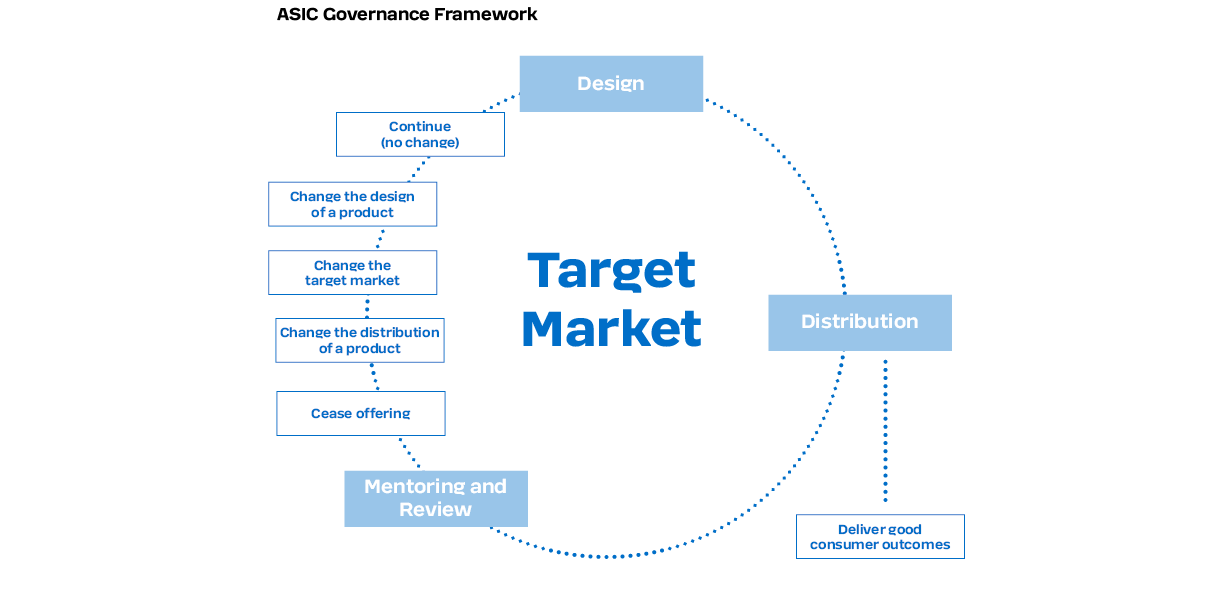
    In the draft, ASIC describes the new laws as introducing a ‘product governance framework’, encompassing not only product design and distribution but also monitoring and post-sales review. ASIC doesn’t intend to produce a template TMD or framework for product issuers, since each will be affected by the nature, scale and complexity of an issuer’s or distributor’s business. However, it considers TMDs need to be sufficiently specific as to exclude consumers whose financial needs the product is not likely to meet.

    This diagram, taken from its consultation paper, illustrates ASIC’s product governance framework

    ASIC expects all levels of the business, including senior management, will embrace the product governance framework, will understand it and will implement it daily. The commission emphasises the need for insurers and other issuers to consider their products’ ‘choice architecture’ – the features in an environment that influence consumer decisions. In particular, consumer vulnerabilities should be front of mind.

    In this way, the consumer target market remains the central focus of product design and distribution.

    What to look out for

    Here are five important features of the new laws and of ASIC’s guidance to carefully consider:

    1. The new laws will apply to the ongoing distribution of existing products, not merely new products developed after April 2021, which means that all retail client renewals due after that date will need to be considered against a TMD. ASIC expects insurers to analyse the data they hold to reduce the likelihood of offering renewals to consumers who are no longer in the target market (for example, renewal of a comprehensive motor policy on a vehicle that has become old).
    2. Although the law does not require it, ASIC considers it useful for issuers to consider which consumers are not suited to their products (the ‘negative target market’) and to specify the negative target market in the TMD.
    3. Bundled products, such as home building and contents insurance, will require separate TMDs and this would seem to include unrelated products such as home and motor insurance that are packaged at a discount as part of a promotion.
    4. TMDs must be publicly available and this also means that advertisements must inform consumers where the TMD can be obtained.
    5. Designing appropriate ‘choice architecture’ extends to website design, which can be expected to come under greater scrutiny from ASIC.
    What to do now

    Although the design and distribution obligations (DDO) come into effect in 2021, insurers should start identifying any potential issues with their retail business in meeting ASIC expectations. This may include:

    • Assessing the value offered under each current or proposed product from a customer perspective
    • How they intend to determine the target market for each product and whether adequate information is being collected to allow a target market (and consequently those customers who may sit outside the target market) to be appropriately determined
    • Analysis of enquiries, disputes and/or other customer satisfaction data, which may provide some evidence of customers being sold unsuitable products
    • Appropriateness of distribution arrangements for each product, noting that distributors will also be required to take reasonable steps to ensure that distribution is in accordance with the TMD when the new laws come into effect
    • Having a robust product monitoring capability, which will be a key component of the product governance framework.

    [1] Financial System Inquiry – Final Report, The Treasury, November 2014, p.198.

  • Meet our grads
    Aidan Robern

    Studied: Bachelor of Economics, Masters in Public Policy
    Joined Taylor Fry: November 2018
    Location: Sydney
    Home team: Government

    We didn’t even force him to wear the T-shirt

    With qualifications in economics and public policy, what enticed you to the actuarial and analytics consulting world – and to move from Canada to Australia as well?

    At university, what interested me most were the statistics courses, where I learned to use quantitative methods such as econometrics in evaluating public policy and designing programs to help the most vulnerable people experiencing the worst outcomes.

    I was excited to work in an actuarial and analytics consultancy at Taylor Fry, where ‘evidence based’ really means something, where people use proven analytical methods to influence positive change.

    As for moving countries, I was never looking to leave Canada! Then I met a former Taylor Fry employee at a networking event through my masters program in Ottawa, where we were assessing a policy issue together. She liked how I was able to look at a few charts and identify who was suffering from this policy and who was missing out. She said, “I know a firm that does some really cool, cutting-edge analytical work in the government space in Australia and New Zealand, and you should contact them. She introduced me to [Taylor Fry co-founder] Alan Greenfield via email, and the rest is history!

    How have you settled into the work environment?

    It was an extremely steep learning curve! Back home, after my masters, I worked for about six months as an economist in the Ontario government. It was a role that greatly improved my communications and critical thinking skills, and which included some quantitative work, but nowhere near the degree of statistical rigour I’ve encountered here. What helped at Taylor Fry was managers and principals giving me the time to develop my skills and ensure I was on a broad set of projects that allowed me to utilise my qualitative skills in program evaluation, along with developing coding and statistics skills.

    Has it met your expectations?

    Yes, because I’d researched what actuaries were and the work Taylor Fry had done with the Ministry of Social Development in New Zealand, which was widely publicised. I was passionate but not experienced, so I was excited and nervous, knowing it would be challenging but hopeful I’d be part of projects to effect some change for government and society – and I have been!

    In what way does your economic and public policy background complement the actuarial and analytics work – does it give you a different perspective to the way you approach projects?

    Actuaries seem to be the masters of prediction. In my economics and public policy background, the focus is less on what will happen and when, but why – it’s a different but complementary perspective. I’m curious about causal links, the story behind an event.

    If you’re going to enact public policy, identifying who to target is complex. Taking a really accurate prediction and looking for the underlying characteristics that may affect what happens next adds an extra dimension, and I’ve had some good feedback with this approach.

    No haters, just players in the Taylor Swifts

    How does the work and work culture in Canada translate in Australia?

    I love that Australia seems to have a better commitment to work-life balance and leave entitlements. I’ve also been impressed at the rate grads at Taylor Fry pick up the work. Australia seems to do a very good job of preparing people for a professional environment straight out of university.

    At Taylor Fry, often the directors will be coding right along with the grads, and everyone is a valuable member of the team pretty much within a month. It doesn’t feel very hierarchical, which makes it much easier to ask a senior person a simple question.

    That’s the big difference for me, coming from government, which is such a massive machine where teams and departments tend to be very siloed. Here, I love the emphasis on knowledge sharing, which carries through beyond individual projects. For example, our ‘talking points’ sessions [where someone will present to the rest of the firm on recent work by their team], workshops, the team meetings and the R coding forum are all so helpful.

    I’m not an actuary, so I wouldn’t ever see myself at a typical insurance-based consultancy. My passions lie in analytics but also in public policy, social outcomes, helping the vulnerable and improving the world for everyone. That’s why Taylor Fry appealed to me.

    What excites you about analytics and have you had an opportunity to explore it here?

    The incredible potential for modelling analytics to do good in the world excites me – using the wealth of data governments own to draw insights that can help people. I’ve had a great chance to explore this, having just finished a two-month stint in New Zealand working for the Ministry of Social Development. It’s a spectacular project, using predictive modelling to forecast what the vulnerable population is going to look like into the future at a micro level. That’s extremely powerful, and such a good use case for why analytics matters for government.

    What’s your advice to someone from a non-actuarial background who may be considering jumping ship, too?

    If you have a passion and demonstrated ability to do maths at a strong level, and you want to be on some cool and innovative work and have a chance to learn a lot, then I think it’s something you should look into – as long as you go into it with no ego. If you ask the right questions and you’re not afraid to ask for help from the experts here, you’ll do fine.

    Not the type of modelling Aidan originally had in mind …

    You’ve decided not to take on actuarial study. Was that difficult and how do you see it influencing the type of work you’ll do?

    I’ve struggled with the decision for the past year, but ultimately my partner and I would like time to explore Australia, plus I’ve already learned so much on the job. Taylor Fry offers generous study leave, so it was a sacrifice. It could help me significantly in my career future and I would encourage anyone considering it to take it on, but it makes sense for us to make the most of this adventure.

    As a non-actuary, I am unlikely to be a part of certain types of work – general insurance valuations, for instance. But Taylor Fry does enough work in the analytics, government, regulation and data visualisation spaces to keep me busy.

    When I’m working with clients, while it might take me time to pick up on the code, I’ve had a lot of positive feedback, where they’ve felt I’ve understood their business case from the beginning, asking them the right questions and taking a more strategic approach.

    What has a secondment taught you?

    First, it taught me that Taylor Fry is well respected. It also taught me about the power of your advice. On secondment, often I would be the only person from Taylor Fry with the stakeholders, and whatever I’d say was reflective and representative of the company. There’s a huge amount of reputation at risk. If you’re going to give advice that may require a big change, always have it peer reviewed by someone with more experience. The last thing you would ever want is to give advice and realise later you’d made a mistake and it’s already gone to the general manager, and a policy has been implemented. It taught me to be rigorous.

    On the social front, you’re quite involved in the activities offered at Taylor Fry. What motivated you?

    I like sports and I like how Taylor Fry has sports going on all the time. I look forward to Thursday’s basketball. I always have my gear ready and if people aren’t ready to play, I try to egg them on to play. It’s important to be with your colleagues during the workday but also to get out of the office environment, expend some energy and have fun together – collaborating in a different setting.

    It’s actually the healthiest workplace environment I’ve ever experienced. I love that on any given day, you can sit at the lunchroom table and people will be doing the newspaper quiz together. And I can have a beer in the office with everyone on a Friday afternoon – you wouldn’t see that too often in Canada!

    Want to know more about our program? Head over to our graduate program page.

  • Meet our grads
    Stacey Lin

    Studied: Bachelor of Actuarial Studies (Hons)
    Joined Taylor Fry: February 2017
    Location: Sydney
    Home team: Government

    Stacey remaining professional despite the threat of an ibis attack …

    When did you know you were ready to move from a behind-the-scenes role to dealing more directly with clients?

    After about six months as an analyst, I became more aware and interested in what the client cared about, rather than being bogged down in the technical detail.

    One of the principals who has been helping to mentor me here, Ash Evans, began encouraging me to take on more responsibility, step by step, creating a very safe environment and urging me to ask questions. As my responsibilities increased a bit more each quarter, I built on my progress in a structured way. I was able to do this over time on a single job with a single client, which helped enormously.

    Ash guided me through, giving me feedback and, after about nine months, I felt comfortable interacting with the client. Ash knew my ability at each stage of development very well and gave me tasks suitable to my skill level along the way. He still does!

    The clear sign for me that I was progressing was when I began to truly understand the client’s questions, when I began to look behind a question to find what was really being asked, even when a client occasionally asked something completely different!

    How did your work change to facilitate the process?

    The first thing was to start to incorporate my interest in what was important for the client into my work. Ash used a top-down approach, which was incredibly helpful, teaching me how to ask summary questions, so I could form a clear picture of the client’s objectives and goals. Thinking of the broader purpose helped guide me through the technical detail, so I wasn’t overwhelmed by it.

    My main focus is always to deliver information that’s valuable and interesting to a client. It’s particularly important to translate the numbers into insights the client will find meaningful. For example, instead of saying, the frequency of a certain claim segment is going up by .2 per cent, I’ll say, this means you may see a $2 increase in the risk premium. The client’s interested in knowing the impact or consequence of the emerging trend on their business.

    How did you start to develop soft skills, such as client engagement?

    Ash told me to be confident. He made me think I could do it. Before you can take a step forward, you need recognition by people you respect. Their support and encouragement mean so much.

    Again, it’s all about taking the client’s perspective – thinking about their goals, interests and objectives before you speak. It’s not about talking fancy – it’s simple, really – when you talk about the things they care about, then they’ll listen to you. The next step is learning how to preempt the questions a client may ask.

    The most enjoyable part of consulting is trying to find the root cause of a problem and making sense of it.

    The key is to keep an open mind. I like to think of it this way: it’s a relationship that involves more than a transaction between yourself and the client, and the learning goes both ways. For example, recently a client shared some ideas with us, proposing tasks that provided an interesting framework we could refine, rather than reverting to what we came up with originally. This type of collaboration is incredibly helpful and allows us to build on things that are already working for a client.

    When you’re pretending to work, but actually drawing giraffes

    How does this contribute to enhancing your confidence?

    Learning to engage with clients and seeing my progress is confirmation I’m on the right track. To me, it’s like a transition from being book smart to becoming a problem solver.

    What is the most challenging aspect of consulting for you? What is the most enjoyable aspect?

    Often it’s challenging to judge what’s most important to tell a client. We can get very excited with data because we’ve done a fancy trick to uncover some truth. But this may not be statistically relevant to the client’s bottom line or material enough to bring to their attention – and may inadvertently cause them unnecessary worry.

    The most enjoyable part of consulting is trying to find the root cause of a problem and making sense of it. It’s great to give a client something tangible they may not have been able to navigate alone.

    For example, by combining multiple government datasets, we’re able to provide new insight into why some vulnerable people require greater support than others, say due to intergenerational risk factors such as having a parent in custody, or a parent who has been the victim of domestic violence.

    What sort of opportunities do you find to continue practising soft skills?

    Conveying information well is such an integral part of the job, so I have lots of opportunities to practise, whether it’s needing to clearly explain a project and the insights gained to new people coming on to a job or just sharing with colleagues about interesting things we’re doing.

    Client engagement is an especially big part of effective communication. I now conduct phone calls independently with clients, as well as travel interstate on my own for meetings and training with clients. I also recently co-presented with one of our principals as part of my continuing mentoring process, and I’m being trusted to contribute to writing the first drafts of proposals and reports.

    If only we all looked this enthusiastic on the way to work

    How are you involved in winning work, for example, contributing to proposals and pitch decks?

    Keeping up to date with a project by collaborating is key. Then I try to find a gap, an idea to update the model we may be using. This happened recently, where Peter Mulquiney, the principal I was working with on the project, saw potential in my idea. He helped me develop and structure it, and encouraged me to ask the client if this was something they might want. It was a great feeling of being heard and valued. It also helped that I was presenting to a long-term client. We know them well and I was comfortable pitching ideas to them.

    What’s most important in presenting compelling information to stakeholders?

    It’s critical to understand what the client cares about, making sure you address what’s most important to them first. You build on this with a robust methodology and focus on transferring knowledge effectively. Beyond that, it’s a bonus if you can try preempting what a client may be interested in doing but hasn’t thought of yet themselves.

    What are the pros and cons of managing people in a team?

    The pro is that you’re pushed to grow faster in the role with greater responsibility for people and projects. The con is that because it’s more challenging, you’re a bit more stressed. When I’m managing a piece of work, it’s constantly on my mind. When I’m just another member of the team, I put my trust in whoever manages the job. As long as I finish what I’m meant to do, I’m carefree. It’s very different when I’m in the role of responsibility.

    How involved are senior people in this transitioning process and what has been most helpful to you?

    Very senior people, at principal level, have been extremely involved and played a big role in my transition, giving me valuable support along the way. Ash, Peter and Richard Brookes [another Taylor Fry principal] have been incredibly generous with their feedback, encouragement and recognition, which has been important to help me grow. Because of them, I’m not running forward like a headless chicken, directionless. It’s like finding yourself in a foreign country – they have been the street signs and directions to help me navigate the path.

    Want to know more about our program? Head over to our graduate program page.

  • Meet our grads
    Jason Gu

    Studied: Bachelor of Actuarial Studies, Bachelor of Commerce
    Joined Taylor Fry: February 2019
    Location: Sydney
    Home team: Analytics

    Jason’s definitely answering a client email …

    How did you feel walking in the door on your first day?

    Nervous! But also excited to meet the other grads and more junior staff, and hoping we’d get along. I’d heard there were lots of PhDs in the company, so my perception was that Taylor Fry was a place full of smart people. And it’s true! That was intimidating at first, but everyone’s so supportive and approachable, even up to senior principal level – and I’m glad I can work in a place with so many experts in their field.

    Did anything surprise you?

    I was surprised by how many people came from diverse backgrounds – like me with commerce –although these were mainly in quantitative areas such as physics and chemistry, so I guess that part was to be expected. I was encouraged and inspired that these people were pursuing an actuarial career. I didn’t feel so alone, because there were people who had gone before me.

    What did you learn from our buddy system?

    It was great to have a buddy to help with fitting in early on in those first few weeks – someone you could ask silly questions and not be judged for them, like how to fix the printer when you cause a paper jam.

    It was quite different from having a mentor at uni, where everyone had fairly similar stories – they were the same age as me, with the same experiences, all studying actuarial degrees, and even from a select few schools.

    My buddy Ian Hutton has a few more years of experience than me, he’s married and has kids, and he comes from a different career entirely – he was a musician previously. It was good to get to know him and his aspirations, why he decided to become an actuary and take on the role. The diversity was refreshing and he broadened my view considerably. He also taught me how to make good coffee!

    “He also taught me how to make good coffee!”

    Will Jason’s coffee meet Ian’s exacting standards?

    Were you able to sample various teams?

    Yes, my home team is analytics, but I found myself working more regularly with the general insurance team because I was placed where the resources were most needed at the time. I’m happy because I’m learning a lot and the work is quite diverse, from valuations for a multi-line insurer to workers compensation for a self-insurer – the liabilities for these are very different.

    I’m looking forward to my rotation back to analytics at some point to experience the different workflow. It tends to be more high pressure, with ad hoc demands and sprints to complete tasks. I’d like to be exposed to that and take on the challenge! That way of working differs from valuations for general insurance, where the groundwork has been laid out in the past and it’s a continuing piece of work, with adjustments made according to issues the company faces.

    I’m also interested in our social sector projects, where governments are looking for the most effective way to spend money to solve a problem. Our job is complex and there are a lot of factors to consider when deciding how to go about the analysis. You need a holistic view of the many influencing variables flowing in and out of that environment. If you try to fix something, you can expose another problem you may not have accounted for. The prospect of this challenge is incredibly interesting and exciting. Luckily, I’ll be able to sample all of these areas as part of our grad rotations.

    How does the knowledge you’ve gained formally compare with your on-the-job learning?

    At work, I learn to apply the more formal education. On-the-job learning is more naturally reinforced because you’re dealing with real-life situations that happen every day. It’s easier to take on knowledge when people around you explain and show you in a tangible, practical way. You get a sense of what’s important and what people care about, versus what’s nice to know.

    I draw on certain parts of my formal university knowledge to help me complete a particular task or project – but it’s the accumulated knowledge from different jobs that helps me build on it and continue to learn.

    Is this what you meant when you said climb the corporate ladder?

    Is the consulting environment what you expected?

    It’s more or less what I expected because I had completed my internship as a consultant with a large data science company, then had a part-time consulting role with a small software company. Taylor Fry seems to have the best features of those two different environments – the benefit of being recognised in the actuarial space as well as the agility of a smaller company, such as more autonomy and flexibility. My experience in both those roles was incredibly beneficial in preparing me for the demands and responsibilities of consulting at Taylor Fry.

    What’s the Taylor Fry uni case challenge and how were you involved?

    We were invited by The Actuarial Society of UNSW to host a case competition, where teams present their solutions to a hypothetical business problem. Alongside our parent company, Qantas, myself and fellow grad Thomas Zhou created a problem centered on a frequent flyer program, and later formed part of the panel judging the final four teams at an evening event at our Sydney office.

    It was such an interesting exercise and much harder than I had anticipated. It was a lot of work for the two of us to come up with a question and all the supporting data that reflected Taylor Fry – who we are, our values and what we stand for as a company. We had some great input and guidance from senior people, who gave up their time to help with setting the direction, tips on education and advising on data, as well as assistance with the formatting, branding and wording of the final package.

    We had more authority to drive the direction of the project than usual, so that was a very different experience for Thomas and me, and we felt the responsibility to achieve a good result. We really wanted to be proud of it.

    We had more authority to drive the direction of the project than usual

    I was pleasantly surprised by how it all turned out. It was a fun night. The students presented their question passionately and enthusiastically – they really threw themselves into it. And I was just so happy people actually wanted to answer our challenge and do it!

    Looking back over the year, how have you changed?

    I’ve become more organised, – I’ve had to! The commitment to full-time work means I plan and appreciate my free time much more, compared with being at uni, where I had two-day timetables. In between work and studying for Part 3s [the final step in becoming an actuarial fellow with the Actuaries Institute], I’ve taken a keen interest in overseas travel, as well as exploring more of Sydney and taking day trips. I’ve even taken up snowboarding!

    Has the experience altered your perception of being an actuary?

    My idea of being an actuary changed when I became aware of the need to consider consequences, that when you analyse data, the results you come up with can have a range of effects on business and people. You have to look quite deeply into a business problem and its environment in order to do that job well, and it’s a skill I still need to work on. But it’s also something that accumulates and develops over time.

    How would you like to see your role evolve?

    I want to continue gaining a broad range of experience, learning more and seeing how everything works – how modelling techniques are applied, and how different problems are solved with different approaches.

    Analytics and the social sector particularly interest me because the work has the potential to have a profound impact on people and society. For instance, providing insight into society’s most vulnerable children and their families enables government to develop new policies and programs with the possibility to improve many people’s lives.

    Analytics is a growing field, too. There’s lots of opportunity for people who can combine it in business, and actuaries fit well into this category. They can also complement their commercial sense with their social conscience, and I’d like to be part of that.

    Want to know more about our program? Head over to our graduate program page.

  • Taylor Fry achieves new ISO 27001 standard

    Taylor Fry has achieved the highest standard of best practice in the industry for its information security management system. The internationally recognised ISO 27001 certification is the culmination of a two-and-a-half-year transformation program within the firm, led by IT manager Thomas McCosker.

    “Being awarded this ISO 27001 standard provides our clients with the confidence to deliver us the rich and often sensitive data sets we need to produce work that ultimately helps them make effective decisions,” Thomas says.

    “It signals we have a mature approach to data security in the provision of our actuarial and analytical services, controlling how we receive, transmit and manage all of our data. There’s not a single part of our IT processes and technology this standard doesn’t touch.”

    Taylor Fry Principal Hugh Miller agrees the certification shows an increasing maturity of the company and says, “It reflects our underlying growth in the number and types of complex jobs we’re asked to do by clients.

    “Our corporate clients benefit from the high standard of data security we’ve had to develop for some of our modelling of highly sensitive government datasets. Implementing information security in a way that ensures security but enables rapid insights is not an easy task.”

    For the three-year certification, Taylor Fry adheres to more than 100 controls, or requirements, and demonstrates a method for implementing each, such as a risk management framework and defined, measurable objectives for our information security program. A mini surveillance audit will be conducted in one year and again in two years, with a full audit completed at the end of the three-year term.

    Thomas adds, “This is recognition we have achieved our IT and data transformation goals, helping to prepare us for information security in the present and setting the framework for us to respond to threats in the future.”

  • Seeing the forest for the analytics trees

    Our models are often built on the high-quality data that we can see, but ignore valuable information that falls outside our usual data collection. Hugh Miller unpacks this idea and analytics work more broadly in his latest column for Actuaries Digital.

    Recently I was invited to a meeting of the Collaborative Partnership, which aims to improve work participation for people with  physical or mental health conditions, by taking a cross-system view. There are some good resources there if you are interested in understanding the ways that different supports are given (through workers’ compensation, insurance and welfare).

    More broadly, the experience reminded me that analytics work is often very good at optimising the ‘known universe’ and often incredibly poor at providing insight outside that universe. For example, in workers’ compensation, a large amount of detailed modelling has been done to understand how injured workers move through the compensation scheme, but there is much less known about what happens once their compensation payments stop. Do they return to work? Or drop out of the workforce and not return? Do they have extended spells on welfare benefits? Or rely on insurance payouts?

    Analytics is often better at optimising the ‘known universe’ than providing insight beyond it

    This type of knowledge gap occurs in all sorts of analytics contexts. For instance:

    • Significant time and effort is now spent on monitoring sentiment from social media, which allows rich detail and insight to be generated on an interesting (but ultimately not entirely representative) portion of the population. Views beyond social media, which are harder to monitor, can be neglected. The gap between digital and non-digital is a consistent area where analytics models are incomplete; digital advertising is likewise a more measurable than traditional advertising spend but usually provides an incomplete picture of the customer base.
    • Insurers can have sophisticated models for certain sales channels (e.g. powerful demand estimates for online quotations) but have relatively crude approaches to other channels. For many years, group life insurance suffered in this fashion. It represented a significant portion of an insurer’s policies but had many unknowns and limited ability for the insurer to understand and manage their underwriting and risk profile.
    • Banks can be incredibly detailed in their understanding of a customer, to the extent that the customer’s accounts, credit cards and loans are bundled with the one bank. But a customer will often have accounts or products with other banks too, leaving a major hole in the understanding of a customer.
    • Government programs (such as housing programs) often cater to a particular cohort of people, for which the characteristics and needs can be well understood. But there will also be people just outside the eligibility of a program who have similar needs, which are sometimes met in other ways. This ‘latent demand’ is potentially invisible to government without significant work.

    Such myopia creates an obvious opportunity to investigate the ‘known unknowns’. While these are, by definition, harder to get right, there are some useful ideas that can help.

    1. A simple but robust answer to a big question can be more useful than a detailed answer to a small question

    Often there are ways to attack the bigger question, for example through using targeted surveys or conducting other research. Such evidence will not be as cutting edge as detailed modelling of the ‘known’ systems, but will enable broader and better questions to be answered. This type of thinking may affect how analytics projects are prioritised.

    2. Partnerships are possible

    In government, increasing use of data linkage is improving our understanding of how people move between systems, or potentially fall through the cracks. For corporates, data partnerships are possible to address similar sorts of cross-system questions, assuming appropriate privacy safeguards and consumer communication are in place. Vertical integration for companies can also achieve a broader customer view.

    3. The biggest risks can lie outside the system

    In the banking example given above, the risk of a customer leaving is significantly higher if they have accounts with other providers. A churn model that does not attempt to explore this risk is missing a trick.

    4. Models are getting better

    While the true status of a customer outside known datasets may be unknowable, it can often be inferred probabilistically from what is known. In such cases, it’s possible to meaningfully talk about the entire population despite the narrower scope of a dataset. For example, mortality rates attached to group life insurance must still be a legitimate subgroup of population-wide mortality, which is well-understood.

    We may never completely solve cross-system gaps. However, by thinking through how pieces fit together, we can reduce the risk that a model carefully built on main company databases becomes quickly outdated as the external environment evolves.

    As first published by Actuaries Digital, 7 November 2019